
¶ WeChat Ecosystem Full Scenario Capabilities
Enjoy WeChat Ecosystem Capabilities More Conveniently with GenAuth!
As a WeChat Ecosystem developer, you may face many confusions when implementing WeChat login capabilities for your application:
What is the creation and configuration process of different types of applications in WeChat?
As a developer of different types of applications, what options are available when implementing WeChat login capabilities?
How to complete the configuration and login of various types of WeChat login methods?
How do you manage the user identity in the WeChat ecosystem after WeChat users log in to your newly developed application?
¶ GenAuth WeChat Ecosystem Function Panorama
If you have the above confusion and don't know how to start, GenAuth WeChat Ecosystem Full Scenario Capabilities can help you implement WeChat login processes in various scenarios. The following table shows the full-scenario WeChat ecosystem operation process supported by GenAuth and the WeChat login capability types available in the corresponding scenarios. You can click directly to learn the required functions:
| Scenario | WeChat Ecosystem Operation Process | WeChat Login Capability Type |
|---|---|---|
| Mobile Application Development |
| |
| Website application development |
| |
| WeChat public account development |
| |
| Mini program development |
| Mini app one-click login |
¶ GenAuth WeChat ecological account system
¶ Basic concepts of WeChat user account system
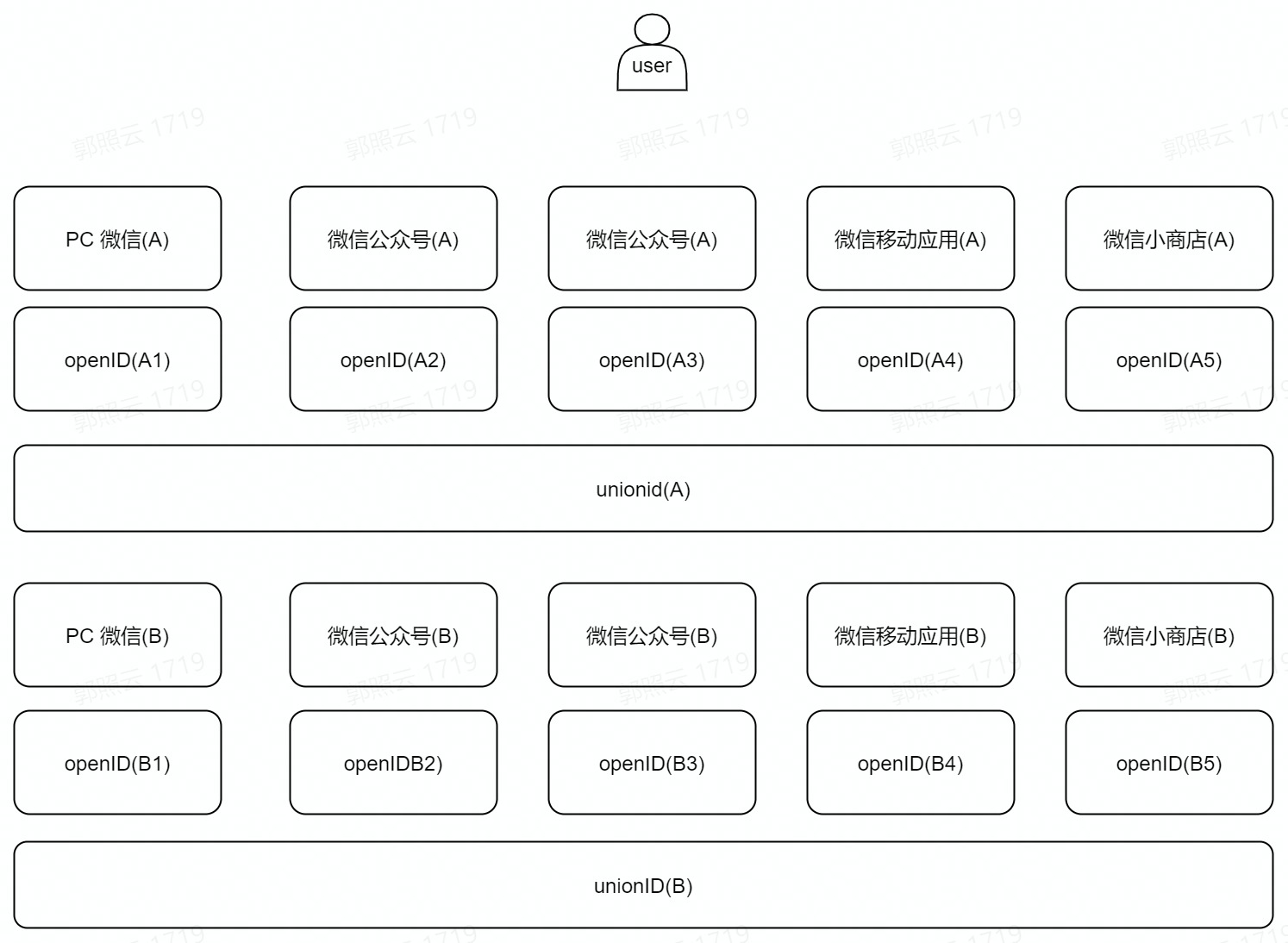
WeChat provides OpenID and UnionID as user identification. The difference between the two is as follows:
| ID Name | Description |
|---|---|
| OpenID |
|
| UnionID |
|
To put it in a figurative way, the unique identification of an independent WeChat user in different login scenarios of WeChat can be shown in the following figure:
¶ WeChat user login process in GenAuth
After understanding the WeChat user account system, it will be easier for you to understand a WeChat user's login journey in GenAuth:

First, your user logs in using one of the seven login methods supported by GenAuth. During login, GenAuth will determine whether the user already exists in your user pool. If so, your user will directly log in to the existing account through this identity source.
If it does not exist, and your GenAuth console has enabled "account binding" for this identity source, it will be judged according to the specific functional logic that takes effect:
The user successfully binds to the existing account and logs in successfully.
Automatically match existing accounts (mobile phone/email) and complete login.
If the match is not successful/binding is unsuccessful, the user cannot log in.
¶ GenAuth Account Solution Based on WeChat Ecosystem
Based on "whether the user exists in the GenAuth user pool" and "whether your WeChat application has been connected to the WeChat Open Platform", there are four scenarios for your account processing:
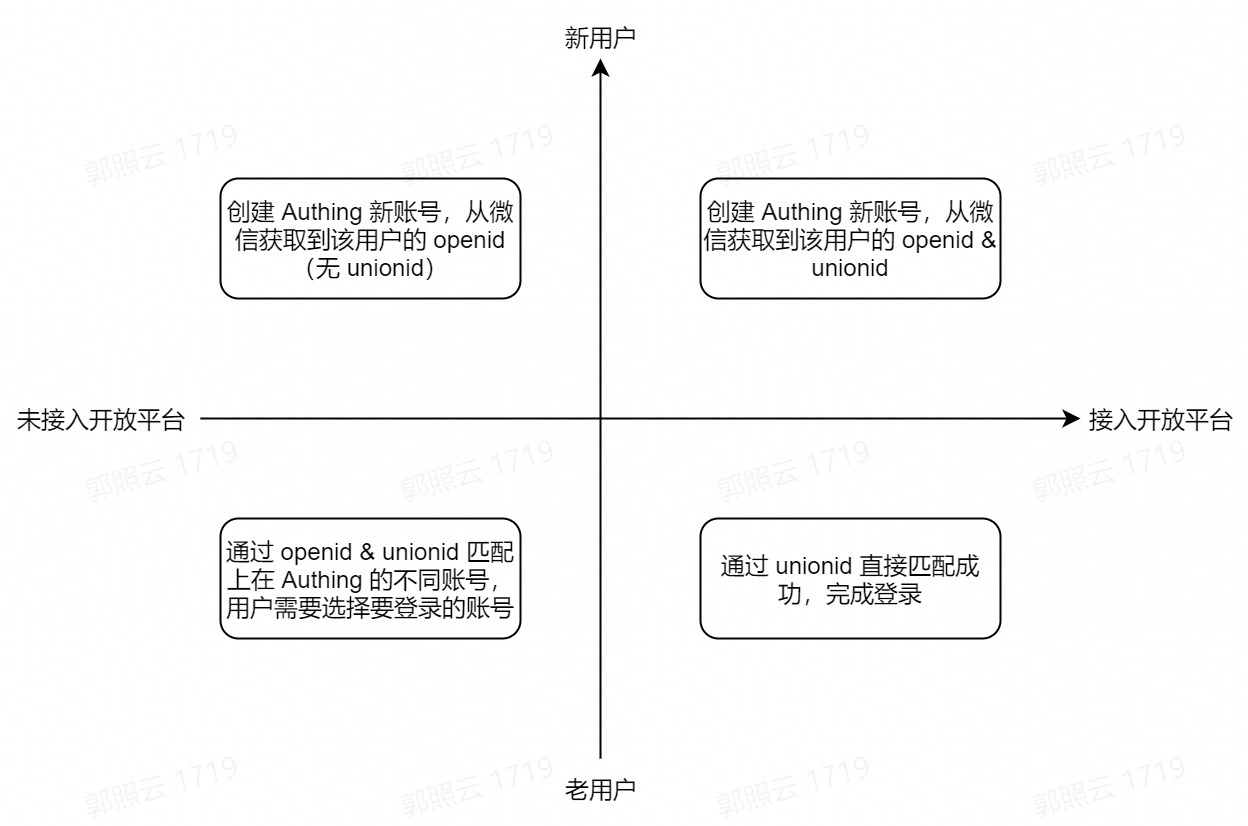
When a user of the WeChat ecosystem enters the GenAuth user pool through WeChat login, there are four possible scenarios, which are considered from two dimensions:
Does the user have
UnionIDin the WeChat Open Platform?Is the user a new user in the GenAuth user pool?
This is divided into four scenarios:
The user has
UnionIDin WeChat Open Platform and is a new user in the GenAuth user pool (first quadrant).
In this case, when the user logs in to the application that has been integrated in GenAuth through WeChat for the first time, a new account will be created in your GenAuth user pool, and the user account information will include the user'sOpneIDandUnionIDobtained from WeChat Open Platform.The user does not have
UnionIDin WeChat Open Platform and is a new user in the GenAuth user pool (second quadrant).
In this case, when a user logs in to an application that has been integrated in GenAuth for the first time through WeChat, a new account will be created in your GenAuth user pool. The user account information will also include theOpneIDobtained from the WeChat interface, but because the WeChat application has not joined the WeChat Open Platform, this account information does not include theUnionID.The user does not have a
UnionIDin the WeChat Open Platform and is an old user in the GenAuth user pool (third quadrant).
In this case, when a user logs in to an application that has been integrated in GenAuth through WeChat, because the account already exists, it will be matched throughOpneIDandUnionIDduring login. When the same WeChat account can correspond to multiple accounts in your user pool due to differentOpneIDandUnionID, account selection will be supported, and login will be completed after selection.The user has
UnionIDin WeChat Open Platform and is an old user in the GenAuth user pool (quadrant 4).
In this case, when the user logs in to the application integrated in GenAuth through WeChat, since the account already exists and there is no situation whereUnionIDdoes not exist, it will be directly matched successfully throughUnionIDand complete the login.
¶ In what scenarios can the GenAuth WeChat ecosystem help you?
¶ More convenient use of WeChat full-scenario login capabilities
¶ More flexible management of user accounts from WeChat
For security and user convenience, you may not want your users to re-create an account every time they log in to GenAuth using their WeChat accounts. GenAuth supports "field matching" and "query binding" to ensure your users' unique identity in GenAuth and ensure that user account information is unified.
For details on the "account binding" function and usage, please refer to account binding.