
¶ Use QR code ticket to exchange for TokenSet
This document is automatically generated based on https://github.com/authing/authing-docs-factory based on https://api-explorer.genauth.ai V3 API, and is consistent with API parameters and return results. If this document description is incorrect, please refer to V3 API.
This endpoint uses QR code ticket to exchange for user's access_token and id_token.
Note: Depending on the application type you selected when creating the application in GenAuth and the exchange token authentication method configured in the application, different forms of client identity verification are required when calling this interface.
Click to expand details
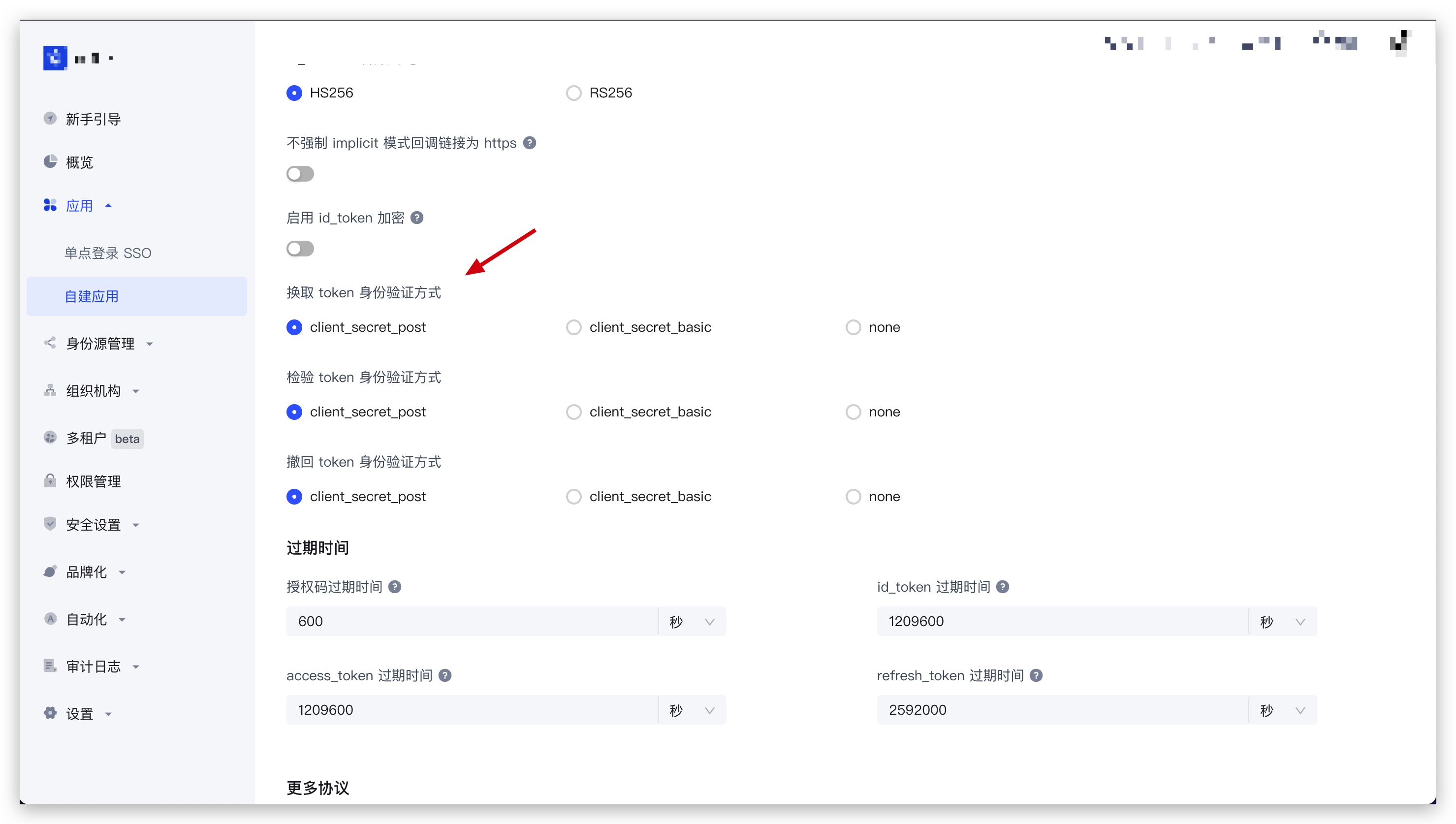
You can find the Exchange token authentication method configuration item in Application - Self-built application - Application details - Application configuration - Other settings - Authorization configuration in the GenAuth console (opens new window):
Single-page web applications and client applications are hidden, and the default value is
none, which is not allowed to be modified; backend applications and standard web applications can modify this configuration item.
¶ When the exchange token authentication method is none
No additional operations are required to call this interface.
¶ When the exchange token authentication method is client_secret_post
When calling this interface, the client_id and client_secret parameters must be passed in the body as conditions for verifying the client identity. Among them, client_id is the application ID, and client_secret is the application secret key.
¶ When exchanging token authentication mode is client_secret_basic
When calling this interface, the authorization request header must be carried in the HTTP request header as a condition for verifying the client identity. The format of the authorization request header is as follows (where client_id is the application ID and client_secret is the application secret key):
Basic base64(<client_id>:<client_secret>)
Result example:
Basic NjA2M2ZiMmYzY3h4eHg2ZGY1NWYzOWViOjJmZTdjODdhODFmODY3eHh4eDAzMjRkZjEyZGFlZGM3
JS code example:
"Basic " + Buffer.from(client_id + ":" + client_secret).toString("base64");
¶ Method name
AuthenticationClient.exchange_token_set_with_qr_code_ticket
¶ Request parameters
| Name | Type | Required | Default value | Description | Sample value |
|---|---|---|---|---|---|
| ticket | string | Yes | - | Returned when the QR code status is authorized. If "Web polling interface returns complete user information" is not enabled in console Application Security - General Security - Login Security - APP Scan Code Login Web Security (disabled by default), this ticket will be returned to exchange for complete user information. | |
| client_id | string | No | - | Application ID. Required when the application's "Exchange token authentication method" is configured as client_secret_post. | 6342b8537axxxx047d314109 |
| client_secret | string | No | - | Application secret key. Required when the application's "Exchange token authentication method" is configured as client_secret_post. | 4203d30e5e915xxxxxx26c31c9adce68 |
¶ Request response
Type: LoginTokenRespDto
| Name | Type | Description |
|---|---|---|
| statusCode | number | Business status code, which can be used to determine whether the operation is successful. 200 means success. |
| message | string | Description |
| apiCode | number | Segmented error code, which can be used to get the specific error type (successful request does not return). For a detailed list of error codes, please see: API Code List (opens new window) |
| requestId | string | Request ID. Returned when the request fails. |
| data | LoginTokenResponseDataDto | Response data |
Example result:
{
  "statusCode": 200,
  "message": "Success",
  "requestId": "934108e5-9fbf-4d24-8da1-c330328abd6c",
  "data": {
    "scope": "openid profile",
    "access_token": "eyJhbGciOiJSxxxxx",
    "id_token": "eyJhbGxxxx",
    "refresh_token": "WPsGJbvpBjqXz6IJIr1UHKyrdVF",
    "token_type": "bearer",
    "expire_in": 7200
  }
}
¶ Data structure
¶ LoginTokenResponseDataDto
| Name | Type | Is it required? | Description | Sample value |
|---|---|---|---|---|
| scope | string | No | Scope corresponding to access_token | openid profile |
| access_token | string | No | API call credentials, authorized to access resource API within a limited time | eyJhbGciOiJSxxxxx |
| id_token | string | No | User's identity credentials, which will contain user information after parsing | eyJhbGxxxx |
| refresh_token | string | No | refresh_token is used to obtain a new AccessToken | WPsGJbvpBjqXz6IJIr1UHKyrdVF |
| token_type | string | yes | token type | bearer |
| expire_in | number | yes | expiration time in seconds | 7200 |